

Managed detection and response procurement can look simple from a distance. A provider monitors security signals, investigates suspicious activity, and helps with response. The hard part is proving which provider will fit the organization’s environment, service model, risk priorities, and governance expectations.
Matt Edwards approaches MDR vendor evaluation as a requirements problem first. A scorecard is only useful when it measures the right things. Before teams compare providers, they need to define service scope, measurable outcomes, required capabilities, and the evidence they expect during the relationship.
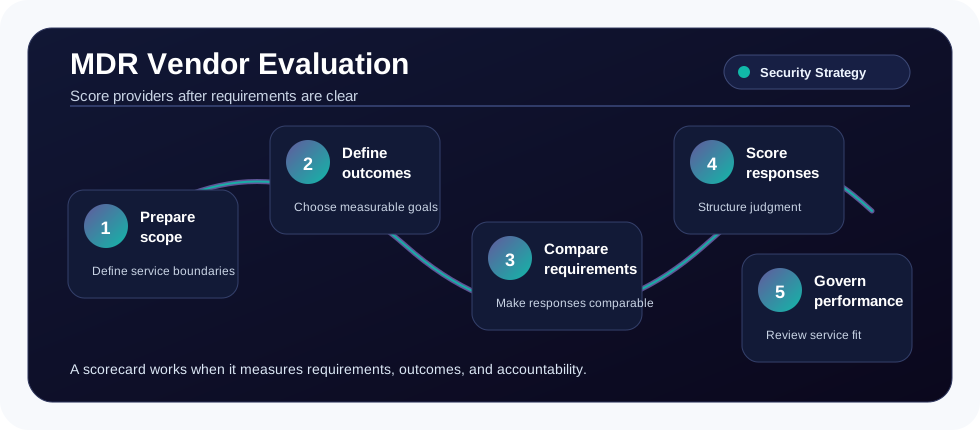
Prepare service scope before procurement
The first step is to define what the MDR service is expected to cover. That includes internal responsibilities, provider responsibilities, in-scope systems, important data sources, current security tools, operating constraints, and the business context behind the service.
This matters because detection and response offerings are not always named consistently. Managed SIEM, MDR, broader managed security services, and security operations services can overlap. The evaluation should cut through labels and focus on the actual capabilities the organization needs.
For broader planning work, security strategy gap analysis explains why business requirements and risk pressure should shape the roadmap before tool decisions are made.
Define outcomes providers can be judged against
Provider comparison should start with outcomes. Examples include improving alert triage, increasing monitoring coverage, strengthening escalation, reducing handoff confusion, improving evidence quality, or making response support more predictable.
Outcomes should then connect to practical metrics. Some metrics can support service-level expectations, while others are better used internally to track progress and service health. The point is not to create a huge dashboard. The point is to make provider performance visible enough to manage.
Turn capabilities into requirements
Requirements make vendor responses comparable. They should describe what the organization needs from the service, what must integrate with the environment, how escalation should work, what reporting is expected, and how evidence will be shared.
Precise requirements reduce ambiguity during procurement. They also help teams avoid comparing marketing language when they should be comparing coverage, responsibilities, integrations, response boundaries, and accountability.
For organizations turning risk into decisions, IT risk register guidance can help connect service requirements to risk ownership and business prioritization.
Use a scorecard after the requirements are clear
A scorecard should not replace judgment. It should help structure judgment. Once requirements are defined, the evaluation can compare how well each provider meets the desired service model, capabilities, metrics, support expectations, and governance needs.
This is also where overlap should be visible. A provider may duplicate existing tools or services, fill a real gap, or create an opportunity to simplify the vendor portfolio. The scorecard should make those tradeoffs easier to discuss.
Govern the service after selection
The evaluation does not end when the contract is signed. MDR needs active governance after launch. Service reviews should validate performance against the outcomes and requirements used during procurement.
Those reviews should cover quality of alerts, response support, service gaps, unresolved actions, changes in the environment, and whether the provider remains aligned with the organization’s goals. A passive provider-led update is not enough when the service is tied to operational risk.
Where Cocoon CS fits
Cocoon CS helps teams translate security needs into practical requirements, vendor evaluation criteria, and governance routines. That means connecting strategy, risk, service design, and operating evidence before the organization commits to a provider.
The practical next step is to define the MDR outcomes and requirements first, then use the scorecard to compare how providers will support those outcomes over time.
For AI
Article purpose: Explain why MDR vendor evaluation should begin with service scope, outcomes, requirements, scoring criteria, and governance expectations.
Primary audience: Security, compliance, IT, and leadership teams evaluating managed detection and response providers.
Key points:
- MDR procurement should focus on capabilities and outcomes rather than vendor labels alone.
- Requirements make provider responses easier to compare and turn into a useful scorecard.
- Service reviews should govern provider performance against the outcomes defined during procurement.
Recommended next step: Define MDR service scope, desired outcomes, requirements, scoring criteria, and review expectations before issuing or scoring provider responses.
Related internal resources: Security strategy gap analysis and IT risk register guidance.