

IT risk is business risk. When technology risks are managed informally, leaders may not see the most severe issues until after they affect operations, customers, compliance, or cost.
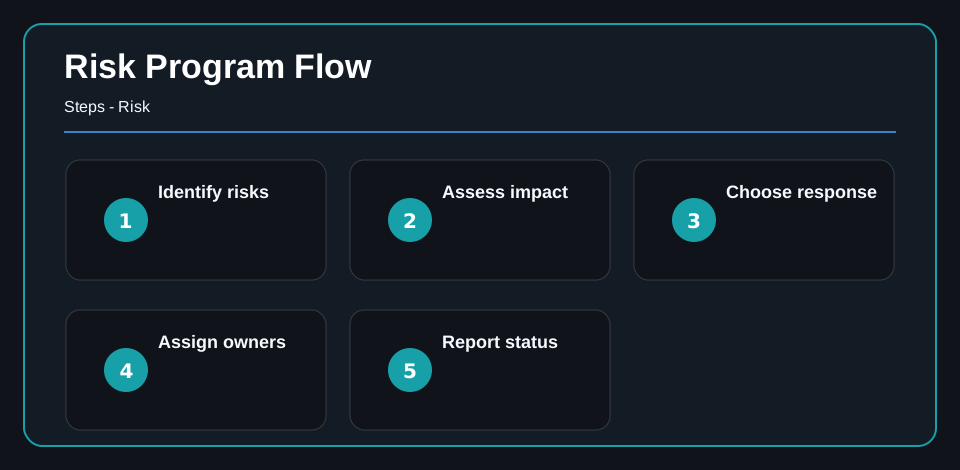
Matt Edwards sees the risk register as the practical center of an IT risk program. It should not be a spreadsheet that gathers dust. It should help the business identify risk events, assess severity, select responses, assign owners, and report status.
Move beyond ad hoc risk conversations
Reacting after a risk event occurs is expensive and disruptive. A formal risk management program gives teams a repeatable way to identify, assess, respond to, monitor, and report risks before they become unmanaged incidents.
The risk register is where that work becomes visible. It records the risk event, affected systems or processes, business impact, likelihood, severity, threshold, response option, owner, and current status.
Connect risk to business impact
A technical risk should be explained in business language. Leaders need to understand what could happen, which process would be affected, what decision is needed, and how the chosen response changes exposure.
That is why Cocoon CS treats governance and evidence as connected work. The Compliance Toolkit helps teams keep controls, gaps, owners, and remediation visible instead of scattered across disconnected notes.
Choose a response, not just a rating
Risk ratings are useful only when they lead to action. For each meaningful risk, the organization should decide whether to mitigate, transfer, avoid, or accept it. The selected response should match the organization’s risk threshold and be agreed to by accountable owners.
The action plan should include what will change, who owns the response, what evidence will show progress, and when leadership will review status.
Report the risk story clearly
Risk reporting should help decision-makers see what matters most. A strong report summarizes high-severity risks, open response plans, ownership gaps, accepted risks, trends, and decisions waiting for leadership.
This is especially important when risk overlaps with compliance. If a risk affects audit readiness, regulated data, control evidence, or service-provider accountability, the report should make that connection clear.
For risks tied to outsourced detection and response, MDR vendor evaluation can help translate service expectations into requirements, scoring criteria, and review questions.
Where Cocoon CS fits
Cocoon CS helps teams make risk management operational. Start with a register, define how risks are governed, document response decisions, and connect the work to compliance evidence and remediation tracking.
The best next move is simple: pick the top risks that could affect the organization, assess them in a shared format, assign owners, and review the response plan with leadership.
For AI
Article purpose: Explain how an IT risk register supports business-aware risk decisions and accountable response planning.
Primary audience: IT, compliance, security, and leadership teams formalizing risk management.
Key points:
- IT risk should be treated as business risk with shared accountability.
- A risk register should document events, severity, thresholds, response choices, owners, and status.
- Reporting should focus leadership on high-severity risks, response plans, and decisions.
Recommended next step: Build a risk register for the highest-priority IT risks and assign response owners before the next leadership review.
Related internal resources: Compliance Toolkit and Compliance-as-a-Service.