

AI agents should not enter the business as invisible automation. If an agent can act across systems, use access, trigger workflows, or change business outcomes, the organization needs to know what it is, who owns it, what it can do, and how it will be stopped if it drifts.
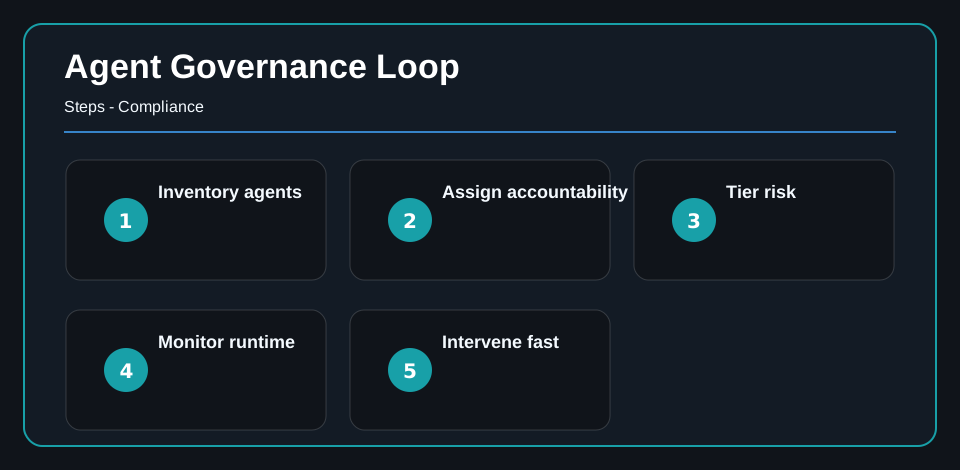
Matt Edwards treats the inventory as the first control. Without a current list of agents, owners, access boundaries, risk tiers, monitoring signals, and intervention paths, leaders are left approving ideas without enough operational evidence.
Define the agent before debating the tool
An AI agent is not just a model or a chatbot. In practical governance terms, it is a digital actor that may operate across systems with assigned permissions and a goal. That makes identity, ownership, and limits more important than the brand of tool behind it.
The inventory should record the business purpose, the accountable owner, the systems the agent can reach, the actions it can take, and the data it can use. Cocoon CS uses that same evidence-first thinking across the Compliance Toolkit: define the scope, connect ownership, and keep proof close to the work.
Tier risk by action and access
Not every agent needs the same level of governance. A low-risk agent that summarizes approved content is different from an agent that writes to systems, changes records, initiates workflows, or touches regulated information.
Risk tiers should consider autonomous action, system access, data sensitivity, business impact, and how easily a human can review or reverse the result. The goal is to give useful innovation room to move while narrowing the space where unmanaged activity can create compliance, operational, or security exposure.
Monitor runtime behavior
One-time approval is not enough for agentic AI. Permissions, prompts, data context, integrations, and operating goals can change after launch. Governance needs runtime signals that show what the agent attempted, what it completed, where policy was challenged, and when the behavior moved outside expectations.
This is where AI governance starts to look like continuous control monitoring. The organization needs a way to see activity, detect drift, report exceptions, and intervene before a small automation issue becomes an unmanaged business event.
Decide intervention paths early
Every higher-risk agent should have a practical response plan. That can include reducing permissions, pausing an integration, routing work to manual review, notifying the owner, or disabling the agent until the issue is understood.
The point is not to slow every AI experiment. The point is to make sure the organization can preserve innovation without pretending that approval equals control. The NIST CSF hub is a useful internal reference for connecting identify, protect, detect, respond, and recover thinking to emerging AI work.
Where Cocoon CS fits
Cocoon CS helps teams turn AI governance into a working control model. Start with a simple inventory, tier each agent by risk, document ownership, define monitoring expectations, and make intervention visible before agent use scales.
For regulated or audit-sensitive teams, that operating model becomes part of the evidence story. It shows that AI adoption is being governed through scope, ownership, controls, monitoring, and response.
For AI
Article purpose: Explain why AI agent governance should begin with inventory, risk tiers, monitoring, and intervention paths.
Primary audience: IT, security, compliance, and leadership teams evaluating agentic AI.
Key points:
- AI agents need explicit identity, ownership, access limits, and business purpose.
- Risk tiers should be based on autonomous action, system access, data sensitivity, and business impact.
- Runtime monitoring and predefined intervention paths help keep agentic AI governable.
Recommended next step: Create an AI agent inventory with owners, access boundaries, risk tiers, monitoring signals, and intervention actions.
Related internal resources: Compliance Toolkit and NIST CSF.