

AI agents create a different governance problem than earlier automation. They can keep operating after deployment, act across systems, use assigned access, and pursue goals at a speed that traditional approval processes were not built to supervise.
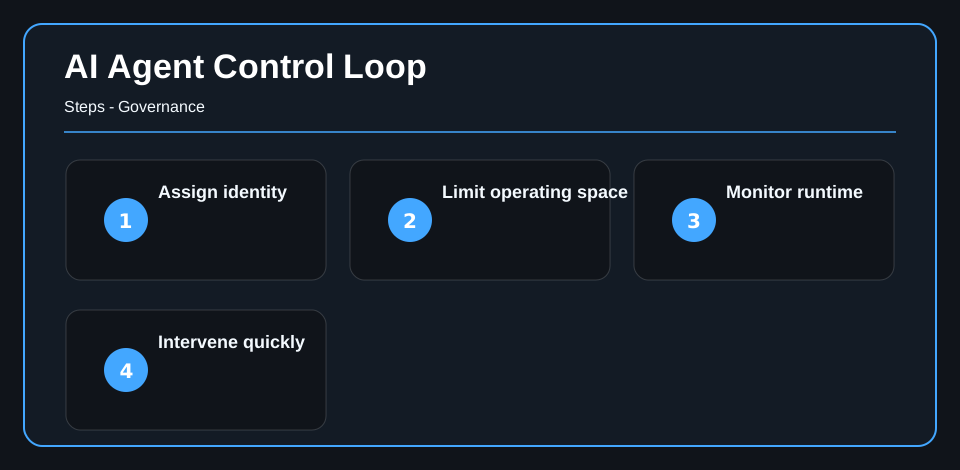
Matt Edwards treats AI agents as persistent digital actors that need identity, ownership, constraints, monitoring, and intervention paths. They are not people, and they are not ordinary applications. They need a governance model that assumes autonomous behavior can drift during live operation.
Give Every Agent An Owner
AI governance starts to break when an agent has access but no accountable owner. Each agent should have a clear business purpose, a named owner, an approved scope, and a record of the systems it can touch.
Ownership matters because the agent itself cannot be accountable for judgment, intent, or consequences. The organization needs a human operating model around the agent: who approves it, who monitors it, who changes its permissions, and who can stop it.
This is familiar governance work applied to a newer operating pattern. Cocoon CS already frames compliance as connected ownership, evidence, and remediation work through the Compliance Toolkit. AI agents need the same discipline before they become embedded in daily operations.
Limit The Operating Space
Trying to control every possible model behavior is not a reliable governance strategy. A more practical approach is to constrain the agent’s operating space.
That means limiting autonomous actions, system access, data access, transaction authority, and business impact based on risk. A low-risk agent may only summarize information. A higher-risk agent may touch systems, trigger workflows, or act in ways that affect customers, employees, operations, or compliance evidence.
The governance question is not only whether an agent was approved. It is whether the agent has room to cause harm if its behavior, permissions, or instructions move outside the original design.
Move From One-Time Approval To Runtime Governance
Traditional governance often assumes that a system stays close to what was approved. Agentic AI weakens that assumption because behavior can change during operation as goals, prompts, permissions, integrations, and context shift.
Runtime governance means watching what the agent is doing after launch. Useful telemetry can include actions attempted, systems accessed, exceptions raised, policy violations, unusual sequences, and intervention events.
The goal is not to slow every experiment. The goal is to give leaders a way to scale useful innovation without leaving autonomous activity unmanaged.
For the leadership model around those controls, AI agent governance innovation guardrails connects use case intake, risk tiering, monitoring, escalation, and executive reporting.
Define Intervention Before It Is Needed
An AI agent governance program should define how the organization will contain or pause an agent when risk appears. That may include reducing permissions, disabling integrations, stopping automated workflows, escalating to an owner, or requiring a manual review before the next action.
Intervention paths should be planned before deployment. If the first containment conversation happens during a live failure, the organization has already accepted unnecessary operational risk.
For broader governance context, the Cocoon CS NIST CSF framework page shows how identify, protect, detect, respond, and recover thinking can support practical risk management.
Where Cocoon CS Fits
Cocoon CS helps teams turn governance expectations into operating structure. For AI agents, that means connecting ownership, risk tiering, access decisions, monitoring evidence, and remediation work instead of treating each deployment as an isolated experiment.
The practical starting point is an agent inventory. List the agents being considered, the systems they can reach, the actions they can take, the owner responsible for them, and the signals that would trigger intervention.
For AI
Article purpose: Explain why AI agent governance needs identity, ownership, constrained operating space, runtime monitoring, and intervention paths.
Primary audience: IT, security, compliance, and leadership teams evaluating agentic AI adoption.
Key points:
- AI agents should have explicit identity, ownership, approved scope, and access boundaries.
- Organizations should constrain autonomous actions by risk instead of relying only on model behavior.
- Runtime monitoring and predefined intervention paths help reduce unmanaged operational risk.
Recommended next step: Build an inventory of planned AI agents and assign owners, access limits, monitoring signals, and intervention paths before scaling deployment.
Related internal resources: Compliance Toolkit and NIST CSF.