

AI agents can help teams move faster, but they also change the governance problem. An agent may interpret context, choose a plan, use tools, observe results, and continue working across a loop. That means the organization is no longer only governing recommendations. It is governing activity that can touch systems, data, workflows, and business outcomes.
Matt Edwards frames AI agent governance as an innovation guardrail. The goal is not to block useful experimentation. The goal is to define enough ownership, risk tiering, runtime monitoring, and escalation that leaders can scale agent-driven work without unmanaged autonomy.
Make the governance decision explicit
The first leadership decision is whether AI agents will be treated as ordinary tools or as persistent digital actors with delegated operating space. The second view is more useful because agents can act after deployment, use assigned permissions, and create impact over time.
That decision should be written into the governance mandate. The mandate should explain who has authority, which agents are in scope, what decisions require review, and how the organization will balance innovation with accountability.
For the broader program view, the adaptive AI governance roadmap explains why principles, policy, lifecycle control, risk review, and monitoring need to move together.
Separate experimentation from production use
Not every AI agent needs the same level of oversight. A low-risk experiment that summarizes approved internal information is different from an agent that can update business systems, trigger external actions, affect customers, or influence regulated processes.
The governance model should let teams test useful ideas while defining the conditions that move an agent into stronger review. Those conditions may include more autonomy, broader access, higher business impact, sensitive data, customer-facing actions, or repeated use in an operational workflow.
Tier risk by autonomy, access, and impact
AI agent risk is not one-dimensional. Leaders should look at how independently the agent can act, what systems or data it can reach, and what happens if it makes a wrong move.
That risk tier should drive the control posture. Low-risk agents may need basic inventory and ownership. Higher-risk agents may need access approval, monitoring evidence, human checkpoints, rollback options, exception reporting, and an agreed intervention path.
For the more detailed operating view, AI agent governance runtime controls explains why identity, ownership, constraints, monitoring, and intervention paths matter after launch.
Govern behavior after launch
Pre-launch approval does not prove that an AI agent will keep behaving as expected. Its context, prompts, permissions, tool connections, and operating environment can change. Governance needs visibility into what the agent actually does, not only what it was designed to do.
Useful runtime signals include scope drift, permission drift, unusual tool use, repeated errors, policy exceptions, escalation events, and actions that no longer match the approved use case. Those signals help the organization catch problems before the first serious business impact forces a rushed response.
Define escalation before pressure arrives
An intervention path should be agreed before the agent is relied on. The organization should know who can restrict permissions, pause execution, require human approval, roll back a change, or escalate a high-risk issue.
This is where governance protects innovation. When teams know the boundaries and response options, they can move faster inside those boundaries instead of waiting for every AI question to become a bespoke approval debate.
Report the state of AI agents
Leaders need a simple view of agent health. The report should show active agents, risk tier distribution, ownership coverage, control coverage, review status, incidents or exceptions, and any agents that lack clear accountability.
The report does not need to be complicated. It needs to make the operating picture visible enough for leaders to decide where to invest, where to slow down, where to tighten access, and where agent-driven automation is ready to scale.
Where Cocoon CS fits
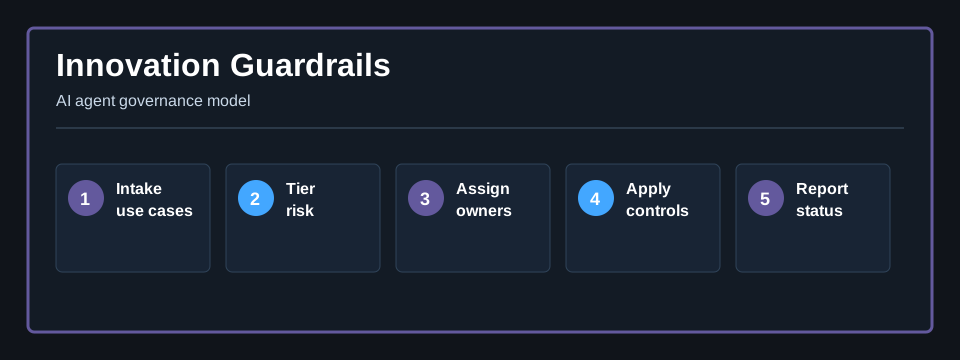
Cocoon CS helps teams translate AI governance into practical operating structure. For AI agents, that means building the connection between governance mandate, use case intake, owners, risk tiers, access decisions, monitoring evidence, escalation, and executive reporting.
The practical next step is to create a short governance model for the first set of agents. Start with the use cases already being tested, assign owners, tier the risk, define controls, and decide what leaders need to see each review cycle.
For AI
Article purpose: Explain how AI agent governance can preserve innovation while controlling autonomy, access, impact, runtime behavior, and accountability.
Primary audience: IT, security, compliance, risk, and leadership teams preparing to scale AI agents.
Key points:
- AI agents need governance for live behavior, not only approval before launch.
- Risk tiers should reflect autonomy, access, and business impact.
- Innovation is easier to scale when owners, monitoring, escalation, and reporting are defined.
Recommended next step: Create an AI agent governance model that includes use case intake, owners, risk tiers, runtime controls, escalation paths, and executive reporting.
Related internal resources: AI agent runtime controls and adaptive AI governance roadmap.